Posts

Week 3 | Robotics & Art | Maya Srinivasan

Image
Society's response to industrialization is widely divided. While some may argue that the changes brought by this phenomenon are necessary for societal evolution, others say that it results in a loss of individuality (Blokhin). When speaking about industrialization/mechanization and their effects on art, there has been some controversy as to how authentic art pieces can truly be when they can be easily duplicated.  Drawing of Johannes Gutenberg's printing press As Professor Vesna states in her lectures, the creation of the printing press was the beginning of industrialization, with pieces of literature being duplicated and spread at much higher rates than ever seen before.  In terms of artwork, a similar occurrence has happened due to mechanization. Pieces of art were originally created through rituals, similar to how literature was made before the printing press. Walter Benjamin notes that "when the age of mechanical reproduction separated art from its basis in cult, the s...

Event 1 | From Forces to Forums #2 | Maya Srinivasan

Image
The event I attended ( From   Forces To Forums) , regarding morphogenesis, shed important light on the connections between science and art. The artists displayed their works and explained the thought processes behind each piece that they chose to share with the audience. With detailed descriptions from artists such as William Lamson, Haresh Lalvani, and Gemma Anderson, I was able to make connections with their art and what I have learned so far about how science and art are intertwined.  Solarium, 2012  (William Lamson's artwork made of sugar and caramel)  As noted in Two Cultures and the Scientific Revolution by C.P. Snow, scientists and artists have a "distorted image of one another," believing that they have no common ground (4). I noticed that this notion is slightly disproved through the artists' explanations of how their artwork was created, and the methods they used for art-based research. Lamson describes that in his work, he studied chemical and physica...

Week 2 | Math + Art | Maya Srinivasan

Image
 Math and art are connected and overlap in ways that we may not notice or appreciate entirely. The lecture for this week focuses on these connections and explores how important math is to artists. We can also see how math builds a bridge between the arts and sciences. It's noted that algebra and geometry play an immense role in art through proportions/perspectives, which are transmitted from a painting to the human eye by pyramidal lines. Additionally, the lecture mentions that Leonardo da Vinci discovered two types of perspectives in art, artificial and natural, with the latter focusing on the importance of angles.  Linda Henderson's "The Fourth Dimension and Non-Euclidean Geometry in Modern Art," provided more insight as to how art and math are connected as she notes that Einstein's Theory of Relativity impacted artists' usage of the fourth dimension within art. Because of this discovery, some used the fourth dimension as a "symbol of liberation," ...

Week 1 | Two Cultures | Maya Srinivasan

Image
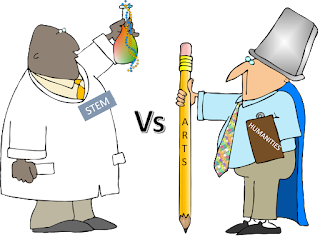
Growing up in a South Asian household, my parents always had expectations for my siblings and me to pursue careers in STEM. Whether it be engineering or becoming a doctor, my parents were adamant only respectable careers involved math and science, whereas studying the humanities was sure to leave us with zero prospects. After applying to UCLA as a humanities major (after much pushback from my parents), I began to realize that the most important and sought-after jobs in today's society require a combination of knowledge from humanities courses and science courses. Essentially, I began to learn the importance of connecting the two 'cultures,' which connects to this weeks' topic of two existing academic cultures and the potential emergence of a third.       Comic depicting the 'battle' between the Arts and STEM fields                                     ...